


The Short Answer
Yes—some borrowers can get a mortgage without tax returns.
Depending on your circumstances, a lender may use W-2s and employment records, eligible bank deposits, financial assets or rental-property cash flow. The right approach depends on how you earn income, the property and the loan program. Other documentation and underwriting requirements still apply.
You may have steady earnings, a growing business or substantial savings and still wonder whether your tax returns will support a home loan. Before assuming you cannot qualify—or that you need a specialty mortgage—start with a more useful question: which records best document your financial situation?
This guide explains the main options, what lenders still review and how to prepare for a conversation about buying or refinancing in California.
Do You Always Need Tax Returns to Get a Mortgage?
No. Requirements depend on the income being used, the mortgage program and the lender's review. A salaried employee and a business owner can have very different documentation needs.
For example, Fannie Mae's base-income guidance allows specified employment verification or a recent paystub and W-2, with additional employment verification. That does not mean tax returns can never be requested; other income sources or circumstances may require more records.
For self-employment, tax returns commonly help establish earnings and business stability. But being self-employed does not automatically rule out conventional financing. Review that possibility before deciding an alternative-documentation loan is necessary.
Three different questions: Having filed returns but using another documentation method, having only one year of returns, and having overdue unfiled returns are separate situations. Tell your mortgage professional which one applies.
Mortgage Options That May Not Require Tax Returns
Start with your income source and intended property use. The comparison below identifies approaches worth discussing; it does not determine eligibility.
| Your situation | Possible approach | What needs a closer look |
|---|---|---|
| You earn a salary or wages | Employment verification, paystubs and W-2s | Income sources and any additional documentation required |
| You work for yourself | Personal or business bank statements | Eligible deposits, business expenses and ownership |
| You have substantial savings or investments | Asset depletion or asset qualification | Eligible accounts, access to funds and balances after closing |
| You are financing a rental property | DSCR investment-property financing | Qualifying rent, property expenses and investment use |
For asset depletion, a lender may convert eligible assets into a monthly qualifying amount using its specified method. An account balance is not automatically the amount used in that calculation. NASB's asset-depletion explanation illustrates this type of approach; our asset-based guide also includes a planning calculator.
What about 1099 or profit-and-loss documentation?
Some lenders also publish 1099 and profit-and-loss programs. For example, Farm Bureau Bank's nontraditional lending overview distinguishes these from bank statement, asset and DSCR options. A P&L program may still require supporting statements. Ask whether a currently available program fits your records rather than assuming one document is enough.
These are examples of documentation approaches, not a list of confirmed SV Mortgage Group lending partners or promised terms. Our self-employed mortgage guide explains how a broader review can help narrow the options.
How Bank Statement Mortgage Income Is Calculated
A business can receive substantial deposits while also paying substantial expenses. Lenders need to distinguish business receipts from money moved between accounts or other deposits that do not represent qualifying earnings.
As one published program example, Angel Oak describes reviewing 12 or 24 months of eligible deposits, with an expense factor applied when appropriate. The actual method depends on the program and your records.
Illustrative Example
$20,000 in monthly deposits does not necessarily mean $20,000 in income.
Suppose a sole business owner provides 12 months of statements. For this example only, assume the lender excludes $24,000 in transfers and applies a 50% business-expense factor to the remaining deposits.
| Total deposits over 12 months | $240,000 |
|---|---|
| Less transfers excluded in this example | − $24,000 |
| Remaining eligible deposits | $216,000 |
| Average eligible monthly deposits | $18,000 |
| After the assumed 50% expense factor | $9,000/month |
Original illustration for this guide. The 50% factor is an assumption, not a universal requirement. Ownership, deposit eligibility and additional adjustments may change the result. This example does not estimate an approved loan amount.
Before moving funds or reorganizing accounts for an application, ask what records the lender needs. A clear explanation of existing activity is more useful than an unexplained change made just before applying.
Can You Get a Mortgage Without Two Years of Tax Returns?
Possibly. Having one year of returns is different from seeking a mortgage without any returns. Fannie Mae permits one year of personal and business returns in certain circumstances, including specified business-history and ownership requirements.
A newer business, a long-established business and a recent change from employment to self-employment should not be treated as the same situation. Share when the business started, your ownership history and your prior work. Ask the lender which documentation rule applies to your actual file.
What If You Haven't Filed Your Tax Returns?
A mortgage program that uses alternative documents does not remove your tax-filing obligations. The IRS instructs taxpayers to file returns that are due even when they cannot pay the full balance. Its past-due return guidance also explains potential consequences of not filing.
Tell your mortgage professional whether you are missing copies of filed returns, have an extension, have overdue filings or owe taxes. If you have a payment agreement or tax lien, disclose that too. These details need individual review; they should not be hidden behind the phrase “no tax returns.”
Tax debt does not always produce the same mortgage outcome. For example, Fannie Mae's debt guidance addresses federal tax installment agreements under specific conditions. A tax professional can help with filing and payment issues while the lender evaluates the financing implications.
What Documents Will You Still Need?
“Without tax returns” describes one part of the application. It does not describe the entire file. Use these categories to prepare for an initial review, then follow the selected lender's checklist.
Income or asset records
Relevant paystubs, W-2s, complete bank statements, investment statements or rental documentation for the proposed approach.
Business information
If applicable, your business history, ownership share and documents explaining how the business earns and receives money.
Funds and obligations
Available closing funds, remaining reserves, existing loans and other obligations the lender needs to evaluate.
Property and transaction
The property address, intended use, purchase or refinance goal, estimated value and requested financing amount.
The CFPB's ability-to-repay explanation describes the financial factors lenders generally must consider and document for covered mortgages. Non-QM financing does not automatically mean that repayment review disappears. Business-purpose investment loans have different considerations.
If you have seen offers described as no-income-verification mortgages, ask exactly what is verified, which properties qualify and what financial documentation is still required.
Compare Mortgage Costs and Requirements
An option that accepts your paperwork is only useful if its terms fit your plans. Ask for a comparison that covers:
- Rate and fees: compare the proposed pricing and closing costs for the same financing goal.
- Cash needed: separate the down payment, closing costs and funds that must remain available afterward.
- Loan structure: understand whether payments can change and how principal is repaid.
- Property use: confirm whether the program fits a primary home, second home or investment.
- Exit plans: ask about applicable prepayment terms, especially for business-purpose investment financing.
There is no single credit-score or down-payment requirement for every no-tax-return mortgage. Rather than relying on a headline minimum, ask for the requirements and costs that apply to your scenario.
Mortgage Guidance for California Borrowers
Whether you are buying in Santa Cruz, refinancing in Monterey or considering a property elsewhere in California, begin with how you earn, what you own and how you will use the property. A city name does not determine the documentation rules.
SV Mortgage Group works with California borrowers from its Santa Cruz and Carmel offices. Shane Valente, NMLS #279284, brings more than 20 years of mortgage experience to reviewing traditional and specialty financing scenarios.
For a useful first conversation, explain what you are trying to finance, why tax returns are a concern and which records you have available. You do not need to know the name of a loan program before reaching out.
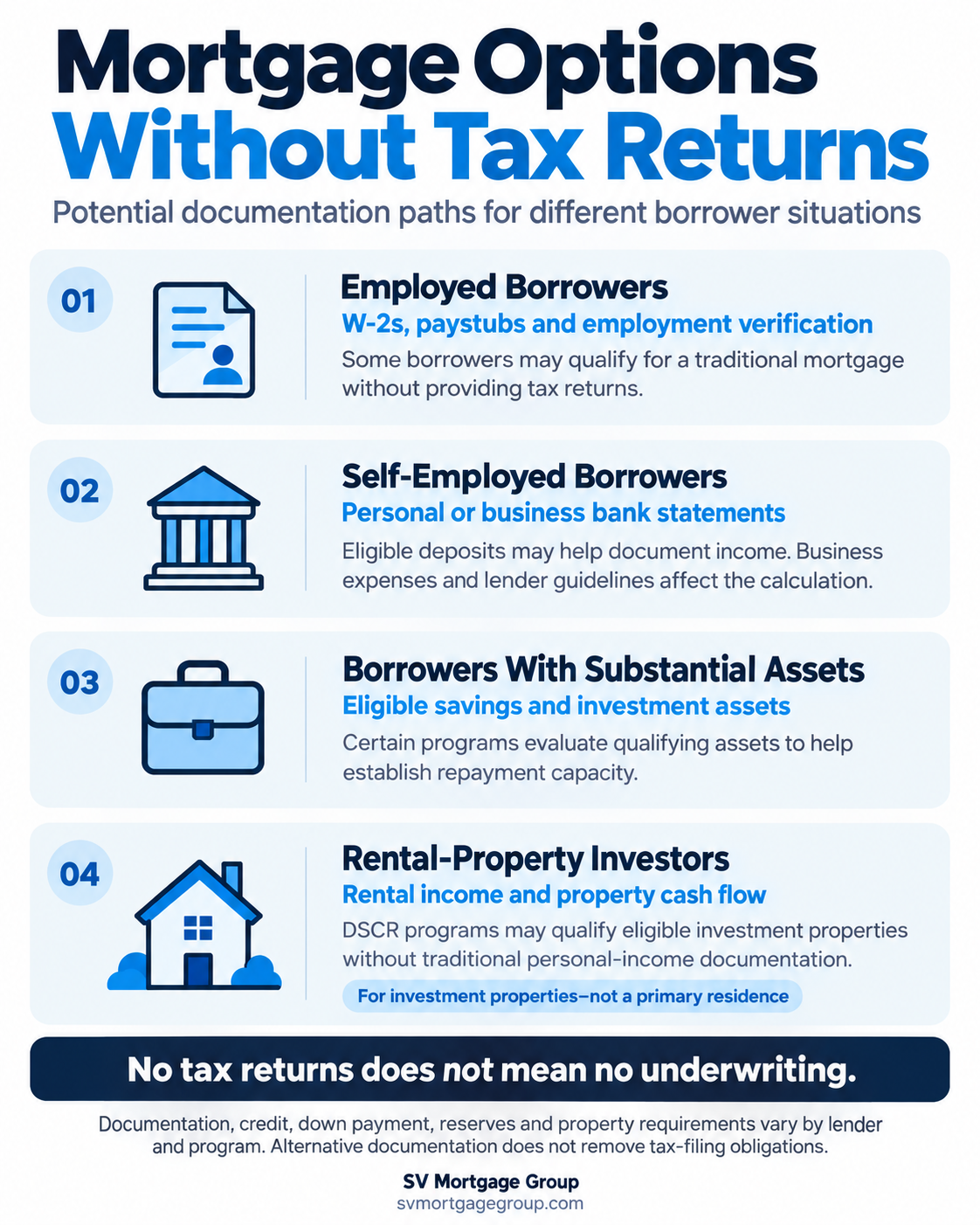
1. Employment-based qualification
If you have straightforward W-2 income, ask whether standard employment documents are sufficient. A no-tax-return scenario does not automatically require a non-QM loan.
2. Bank statement loans
For eligible self-employed borrowers, bank statement loans evaluate documented deposits. Business costs and the source of funds matter; the account's total deposits are not necessarily your qualifying income.
3. Asset-based mortgage options
Asset-based mortgage programs may use eligible financial assets to support qualification. Account type, accessibility and the lender's calculation method affect what can count.
4. DSCR investment-property loans
DSCR loans focus on an eligible rental property's cash flow relative to qualifying property expenses. These investment loans are not a substitute for financing the home you intend to occupy.
Frequently Asked Questions
Can I buy a house with W-2s but no tax returns?
Possibly. Some employed borrowers can document qualifying income through W-2s, paystubs and employment verification. Other income sources, the loan program or the lender's requirements may still lead to a request for tax returns.
Do all mortgage lenders require two years of tax returns?
No. Documentation depends on the income source and mortgage program. Some employed borrowers may not need returns, while certain eligible self-employed files may use one year. Alternative-documentation programs can use other records.
How many bank statements do I need for a mortgage?
Bank statement mortgage programs commonly review 12 or 24 months, but the required period depends on the lender and program. Ask whether personal or business statements are needed and provide the complete records requested.
Do all bank deposits count as mortgage income?
No. The lender evaluates the source and eligibility of deposits. Transfers between accounts and other non-income deposits may be excluded, and business expenses or ownership adjustments may affect the amount used to qualify.
Can I get a mortgage if I have not filed my taxes?
Do not assume alternative documentation resolves overdue tax filings. Disclose your filing status and any tax debt or liens to the lender, and address required filings with a tax professional. Eligibility depends on the complete circumstances and program.
Can I refinance without providing tax returns?
Potentially. Some employment-based or alternative-documentation approaches may support a refinance. The lender still evaluates the applicable financial records, credit, property, equity and transaction requirements.
Can I use a DSCR loan for my primary residence?
The DSCR programs discussed here are for qualifying investment properties, not a home you plan to occupy. If you are buying a primary residence, discuss employment, bank statement or asset-based qualification instead.
Is a no-tax-return mortgage the same as a no-documentation loan?
No. A mortgage that does not use tax returns may still require substantial documentation of employment, deposits, assets or property cash flow, along with credit and property review. Ask what the particular program requires.
Find Out Which Documents Could Support Your Mortgage
Tell Shane about your income, property and financing goals. SV Mortgage Group can help you explore relevant options and understand what to prepare next.
Sources & Further Reading
Sources checked October 16, 2026. Lender pages illustrate particular programs; they do not establish your eligibility or confirm an SV Mortgage Group lending relationship.
Educational information, not individualized mortgage or tax advice, a loan offer or a commitment to lend. Programs and requirements can change. All financing is subject to applicable eligibility, underwriting and property review. Consult a qualified tax professional about your filing obligations.
Infographic © 2026 SV Mortgage Group. Created by Michael Monahan on October 16, 2026.